BUZZ Teachers Notes Volume 1/Number 3 (June 2008)
Back to Buzz 'Welcome' page.
Back to 'About Buzz' page.
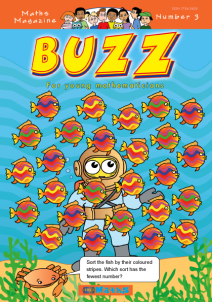
Cover: Which set has the fewest fish?
|
Application: A
sorting puzzle Many
similar fish are swimming around Buzz. It is necessary to sort them into three
sets and count how many are in each set: which has the fewest number? Answers
are provided on page 15 of the magazine so that children can check for
themselves, and full solutions can be found in the online Answers. |
|
|
|
Pupils
look at detail to find difference in shape and colour to sort and count. |
||
|
Resources required: none |
||
|
Learning objective taken from the Mathematics FrameworkCounting
and understanding number. Estimate and then check by counting. Recognise
differences. Problem
solving: making observations and using appropriate language to resolve the
task. |
||
Activities |
Vocabulary/keywords
|
|
|
The
differences between the three sets of fish are the colours; the thickest wavy
line is blue, yellow or green. Ask the
children if they can make an estimate of how many fish are in the picture
(26), and then how many are in each set. Discuss the difficulty in estimating
numbers over four or five (people of ancient times only counted one, two and
many). Ask how
they are to go about counting the three sets: what is the best strategy? How
many can be recognised at a glance before they lose count? Does it help to
count in threes? There are 9 of two sets, and 8 of the ones with green
stripes. |
matches/
same/ difference stripes,
wavy lines sort,
group, type, set many fewest,
(in number) least
(size of group) left,
right top,
bottom over/above under/below |
|
Assessment strategy
Accurate counting and estimating. Vocabulary will be extended using appropriate words. Back to Top |
||
Page
2: Days of the week
|
Application: The
main theme of this issue is time. The
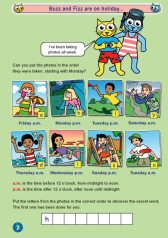
introduction page has a reasoning problem where pupils are asked to put the
eight photos in the order they were taken. Each photo
has a letter, which will spell out a word if the order is correct. Answers
are provided on page 15 of the magazine so that children can check for
themselves, and full solutions can also be found in the online Answers. |
|
|
|
Pupils
put the days of the week in order, and recognise a.m. and p.m. |
||
|
Resources required: pencil |
||
|
Learning objective taken from the Mathematics Framework Use
everyday language related to time, considering order and sequence. Problem solving:
making decisions and using appropriate language to resolve the task. |
||
|
Activities
|
Vocabulary/keywords
|
|
|
A good
starting point would be to discuss days of the week and their order. How many
days are in the week? What words describe the next day, the day before? Although this is quite a simple task,
it requires children to look carefully to find the information they need. The first
day of the week is now officially Monday in most of Europe (as opposed to
Sunday) as defined by The International Standard for date and time. Before
the mid 20th Century it was widely considered to be the second
day, and still is by many religious bodies. Tuesday
appears twice, which gives the opportunity to talk about am and pm, and how
it relates to noon and midnight. Ask, what time could it be when the picture
of Becky in her tent was taken, or the one of Luke starting off on a walk?
Talk about the difference in 7.30 am and 7.30 pm. Each picture tells a story,
and discussion could be had about each one, encouraging oral skills: for
example, lazy afternoons, evening, sunsets and the weather. The
letters by each picture will spell out the word holidays, a useful self-checking device
that comes up in other puzzles and activities in BUZZ. |
Today Tomorrow Yesterday Next Before Days of
the week Months of
the year Midday Morning Afternoon Night Midnight Noon Early Late Evening |
|
Assessment strategy
Being confident in the order of days in the week and their position to each other. Knowing what is meant by am and pm. Vocabulary will be extended using appropriate words. Back to Top |
||
Pages
4 and 5: The one-hour maze
|
Application: A maze invites
the reader to find four different routes that will each add up to 60 minutes. Reasoning
is required to decide on each of the destinations, and mental addition as the
route is tested. The
seagulls provide letters that spell out four simple words. Answers
are provided on page 15 of the magazine so that children can check for
themselves, and full solutions can be found in the online Answers. |
|
|
|
Pupils
solve a problem that involves mental addition. Can be
used to reinforce knowledge of the number of minutes in an hour. |
||
|
Resources required: pencil |
||
|
Learning objective taken from the Mathematics Framework Calculating
with measures relating to time. Understand and use vocabulary related to time;
know and use units of time and the relationship between them; counting up to
60 (adding 2 digit numbers), recognising blocks of time that add up to an
hour. Problem solving, reasoning and numeracy: making decisions and using appropriate language to resolve the task. Back to Top |
||
|
Activities
|
Vocabulary/keywords
|
|
|
This maze
may seem tricky to younger children, in that they have to work out themselves
where they are going and the restrictions on the maze. Some may try to overlook
the fact that each junction has minutes to add up. Help by suggesting they
start with the walk to the lighthouse, which is given, and put in the secret
word supplied by the seagulls in the check box. More
confident pupils will be able to add up the amounts as they go, helping them
to recognise the blocks of time within an hour. For those who find this
difficult, suggest they write down the numbers as they go to help them with
the addition. They could also look for pairs, such as 25 and 5, to make
multiples of 10, which are easier to add up. Talk
about how we refer to different amounts of time: half an hour, quarter of an
hour, and which sections of the routes show these times, Ask, Can you find
where to start to walk to the funfair in three quarters of an hour? Can you describe your route giving
directions? What other routes can you find? What’s the longest route you can
have without going back along the same path? Talk about other occasions we
use time to measure distance: How long does it take to walk to school? To
cycle up and down hills? To fly to another country? The check
boxes will show the words supplied by the seagulls and confirm their routes
are correct. |
Time Hour :60
minutes Route Way Direction Distance Measure Addition Half an
hour Quarter
of an hour Three
quarters of an hour left,
right top,
bottom along |
|
Assessment strategy
More able will be able to calculate the times mentally, and practise will improve this. By asking children to explain directions their vocabulary will be extended using appropriate words. Back to Top |
||

Pages
6 and 7: Time Up
|
Application: Children
are asked to read times in speech balloons and calculate back and forwards from
an hour. They have to decide which canoe is due back first, and draw in hands
on the clock faces for all the boats. Buzz and
Fizz are hidden in the picture. Answers
are provided on page 15 of the magazine so that children can check for
themselves, and full
solutions can be found in the online Answers. |
|
|
|
A word
problem presents a real life context that involves representing and
calculating time. |
||
|
Resources required: pencil |
||
|
Learning objective taken from the Mathematics Framework Simple
word problems involving measure. Understand and use every day vocabulary
related to time; know and use units of time and the relationship between
them; read the time from clocks. Measure short periods of time. Problem
solving, reasoning and numeracy: making decisions and using appropriate
language to resolve the task. Develop mathematical ideas and methods to solve
problems. |
||
|
Activities
|
Vocabulary/keywords
|
|
|
Many
children may have had the experience of being on a boating lake and will
understand having a limited hiring time. A discussion with older children
could be had on when other occasions the measure of time is used in this way
(for hired cars, equipment, holiday rentals, for example). Here they
are asked to read words describing time. The task requires calculating adding
on an hour and relating that to a clock face. Some simply require adding on
an hour to the time they give, others need to be calculated with careful
reasoning to work out when the canoe was hired, by using the time on the hut,
and then adding on an hour to get the correct answer. For those
needing a little help, start by asking what the time is in the picture. Use
the example of Yasmin (number 1). Talk about where the hands would have been
for different Buzz kids, Sasha (number 4) for example, tells us she started
at 11.o‘ clock. Ask, how long has she been on her canoe? What time is one
hour on? Luke (number 3) tells us he has had quarter of an hour. Ask, Can
you show where the hand was quarter of an hour earlier on the clock on the
hut? Use this to talk about how long an hour is less a quarter. Completing
the clock faces will lead to conclusions: Ahmad is due back straight away.
Ask, Who started together? (Jasmin, Luke and Becky all started at half past
eleven for example.) Who is due back next after Ahmad?(Sasha and Lucy.) |
Time Hour 60 / 30/
15/ 45 minutes Measure Addition Half an
hour Quarter
of an hour Three
quarters of an hour Clock
face Minute
hand Hour hand Longer,
longest Shorter Shortest next |
|
Assessment strategy
Calculating time in a real life situation, being able to think about how they go about answering the problems and what process they use. Confidence in calculating forwards and backwards to an hour. |
||

Pages
8 and 9: Ups and downs
|
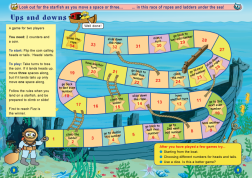
Application: A game
based on the traditional snakes and ladders format, but using a limited
number of moves (1 or 3) and using number facts. Answers are
not required, but the activity invites investigating
other rules to develop mathematical ideas. |
|
|
|
Pupils
look at number and calculating. |
||
|
Resources required: 2 counters and a coin, or dice. |
||
|
Learning objective taken from the Mathematics Framework Knowing
and using number facts, counting and understanding number. Problem
solving: making decisions and using appropriate language to resolve the task. |
||
|
Activities |
Vocabulary/keywords |
|
|
This game
is easily accessible from Year 2 up, although help may be required with
explaining that moves can only be one or three moves, depending on the flip
of a coin. If the flipping of a coin (or two different sided button) is
difficult, a dice could be used, but with the proviso that numbers up to 3
mean only move one place, 4 to 6 mean move three places. The
journey to the surface involves doubling, halving and knowing odd and even
numbers. Ask if
the game is better if you start from the boat. What happens? Having played a
few rounds, encourage children to experiment with their own versions:
different numbers to move or using the whole dice (how does this affect the
time spent playing the game?). Discuss why rules are important and how they
can change a game. |
Add Forward Double Half Even Odd Back Subtract Next 3rd last left,
right up down |
|
Assessment strategy
Confidence in recognising number facts and counting. Back to Top |
||
Pages
10 and 12: Matching Times
|
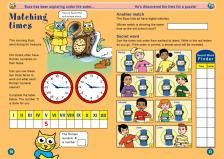
Application: An activity
that involves reading the time from clocks, both analogue and digital, and
looks at Roman numerals in that context. The
second activity involves putting times in order. There is a self-checking box
that gives a word used in the copy. Answers
are provided on page 15 of the magazine so that children can check for
themselves, and full solutions can be found in the online Answers. |
|
|
|
Pupils
look at reading the time from clocks. |
||
|
Resources required: pencil |
||
|
Learning objective taken from the Mathematics Framework Understand
and use the vocabulary related to time. Read the time from clocks, up to 12,
and solve problems involving time describing how the problem was solved. |
||
|
Activities |
Vocabulary/keywords |
|
|
A real
life problem is presented on the first activity, in that the old clock face
uses Roman numerals. Even the youngest pupil may not have too much difficulty
in matching the two clock faces and thereby discover they can read Roman numerals.
For a project, pictures of interesting clock faces could be collected: such
as Big Ben, Town Halls, old railway stations (it may be noticed that some
have llll instead of lV…). Recognising
Roman numerals may be an easier task than knowing the time on the face is
10.15. For those who have difficulty in this, they may find doing some of the
other activities in BUZZ relating to 60 minutes, quarter of an hour, half an
hour and so on, helpful. This can be related to the way the big hand shows
the minutes in an hour. Reading
digital time is usually easier, and all the times here show hours before
12.00 noon (the full 24 hour clock is introduced in the story at the end of
the magazine). Ask, where might they see digital clocks (for example, the
microwave, radio alarm)? This could lead to a discussion of the 24-hour
clock, and the occasional (rare) use of am and pm on digital clocks. Putting
the times in sequence requires some care, discuss which come first: 7.30 or
7.45? The word they will see spelt out is numerals, which is used on page 10. You
may need to explain that this word means the words or symbols used to
represent numbers. |
Time Hour 60 / 30/
15/ 45 minutes Measure Addition Sequence Half an
hour Quarter
of an hour Three
quarters of an hour Clock
face Minute
hand Hour hand Digital Noon Earlier Next Numerals |
|
Assessment strategy
Confidence
in reading the time, both digital and on a clock face. Understanding mathematical vocabulary and recognising Roman numerals in context. Back to Top |
||
Pages
12 and 13: Odds and evens
|
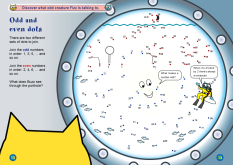
Application: A
dot-to-dot activity that uses odd and even rules. Answers
are provided on page 15 of the magazine so that children can check for
themselves, and full solutions can be found in the online Answers. |
|
|
|
Practice
in addition and calculation, using number facts. |
||
|
Resources required: pencil |
||
|
Learning objective taken from the Mathematics Framework Counting
and understanding number, knowing number facts. |
||
|
Activities
|
Vocabulary/keywords
|
|
|
Dot to
dot puzzles are enjoyed by a wide age range of children, and serve a useful
purpose as number recognition and sequence practice. This one requires more care,
as there are two sets to join up, one using the rule of odd numbers and one
with even numbers. The
numbers go to 94 and 99. Ask, What would be the next number on the odd
sequence? What other way could you describe the set of even numbers
(multiples of 2)? Extension:
An investigational activity that uses odd and even numbers can be found in
BUZZ issue 1 (Sum Socks pages 4 and 5) |
Odd (has
a reminder of 1 when divided by 2) Even
(divides by two exactly) Sequence Set Remainder Whole
numbers Divide |
|
Assessment strategy
Confidence in adding and an understanding of number. Back to Top |
||
Pages
14 and 15: Which Train?
|
Application: Children
are invited to read a story, which involves reading simple timetables and calculating
time. The story finishes with the reader being asked to complete the times
Fizz and Buzz arrived, and how long Fizz had to wait. Brief
answers are provided on page 15 of the magazine so that children can check
for themselves, and go back to puzzles to look at them again if they missed
something. Full
solutions can be found in the online Answers. |
|
|
|
Pupils look at time in a real life context and do some simple calculations. |
||
|
Resources required: pencil |
||
|
Learning objective taken from the Mathematics Framework Understand
and use the vocabulary related to time. Read the time from clocks, and
timetables. Solve problems involving time describing how the problem was
solved. |
||
|
Activities
|
Vocabulary/keywords
|
|
|
Presenting
children with timetables is usually reserved for Year 4, and the 24 hour
clock for Year 5, but more able younger children should also be able to enjoy
this story set in a real life context. Help could be given for the challenging
element beyond simply understanding that Buzz is late again! (A previous
story about time can be found in BUZZ issue 1 Which Pie? Page 14.) Discussion
could be had on how train and bus time tables use the 24 hour clock, and how this
avoids confusion (a brief explanation of the 24 hour clock is on page 15).
The times are not complicated but help may be needed to understand the word,
depart, and discussion could be had on how long the train journey to Sandy
is, compared to the bus journey from Woody to Sandy. This would be a useful
introduction to using real and more complicated timetables. Ask, Where do you
see the 24-hour clock? Children may have come across them on television
listings, computers, posters, electronic equipment, as well as digital
watches. The clock
face in the first picture shows ten to eleven, and in the last frame five
past one. The clock faces are not vital to the understanding of the story,
but present additional information, and an opportunity to ask what actual
times are in the pictures. For those who have difficulty with reading the
analogue clock, they may find doing some of the other activities in BUZZ,
such as Matching Times, page 10, helpful. Ask,
which train does Buzz want to catch? How long does he have to wait for the
next train? What time does Fizz arrive at Sandy? This will help the reader
when asked to fill in the boxes on page 15. The final
question, asking the hands to be drawn in on the clock face, requires
understanding the 24 hour clock, and help may be needed with younger children
to explain this further (12 noon + 5). |
Timetable Depart /
arrive Hour 60 / 30/
15/ 45 minutes 24 hour
clock Measure Addition Midday Midnight Half an
hour Quarter
of an hour Three
quarters of an hour Clock
face Minute
hand Hour hand Digital Noon Earlier Next Numerals how long will it take to? Analogue clock Late longer Add, addition, more, plus Sum, make, total difference |
|
Assessment strategyThis is a challenging activity as it involves a sophisticated level of understanding. Younger children tackling it with ease will be performing at a high level. Back to Top |
||

Page
16: Curious Castle
|
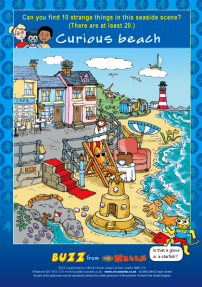
Application: A picture
puzzle that involves observation and reasoning. There are at least 23
different oddities to find. (The
answers on page 15 of the magazine gives 10 things and the full list can be
found in online Answers) |
|
|
|
Can be
used as an introduction to keeping tallies. |
||
|
Resources required: pencil |
||
|
Learning objective taken from the Mathematics Framework Counting,
keeping a tally, describing position. Problem
solving: making decisions and using appropriate language to resolve the task. |
||
|
Activities
|
Vocabulary/keywords
|
|
|
Some of
the curious things will be easy to spot, so all children should engage easily
with this puzzle. Some may not be so easy to recognise. Encourage children to
use language to describe why something is odd: how do you know is it too hot
for a snowman? Do daffodils grow in the sand at the water’s edge? Would a
giraffe mix with the cows? An element of reasoning is required! Suggest
keeping a tally as each oddity is found, to keep a count of their
discoveries. Cooperation in sharing knowledge comes from comparing with each
other to see which ones may have missed. |
matches/
same/ different direction left,
right top,
bottom position over/above under/below beside next upside
down tally count number how many |
|
Assessment strategy
By asking children to describe the location of the strange things they find their vocabulary will be extended using appropriate words. Understanding how make a record of the number they find. |
||
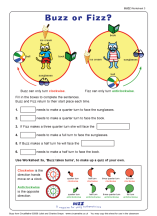
Worksheet: Buzz or Fizz? 3a and 3b (available
online)
|
Application: Buzz and
Fizz present a game where they spin to turn to face an object. Buzz only
turns clockwise, and Fizz anticlockwise. A series
of sentences have missing key words, which need to be filled in. Full
solutions can be found in the online Answers |
|
|
|
Understanding
clockwise/anticlockwise as a direction and turns as part of a circle. |
||
|
Resources required: pencil |
||
|
Learning objective taken from the Mathematics Framework Make and
measure clockwise and anticlockwise turns. Read and write the vocabulary
relating to position, describe turns inside a circle, or on a clock face. Solve
mathematical problems. |
||
|
Activities
|
Vocabulary/keywords
|
|
|
Knowing
the directions clockwise and anticlockwise is important in being able to read
the time on analogue clocks. Filling in the sentences requires the reader to
recognise the difference, and provides practice in using the terms: quarter
turn, half turn, three quarter turn and full turn. In worksheet 3b the child
is invited to add their own objects and write their own sentences to test on
a friend. Deciding on their own instructions will encourage independent
thinking and consolidate their knowledge. Extension: Children could play their own
game of spin. Place four objects in a circle, allow a few minutes to look at
the arrangement, and then blindfold the player. Call out directions,
such as Make a quarter turn clockwise, then the player has to turn, remember where the
objects are, and call out what object he or she is facing. Decide if the
player returns to face south each time, or has to move on from each position.
The directions
could be varied to include times on a clock (6 o clock, 3 o clock and so on)
and the compass points: north, south, east and west. It will be noticed that
the direction of the turns is not always relevant, but could be used to add
to the confusion, as in: turn anti clockwise to face West, or turn
clockwise to face 9 o clock A more
advanced game could be played with clock times: up to 12 objects could be
placed around the player. Starting at the player facing 12: instead of
calling out the hour, minute times could be given, such as: ten past, quarter
to, twenty past, and only clockwise turns allowed. Encourage
experimenting with what makes a good game: whether to have points scored, how
long each player’s go is, how long to allow to memorize the objects.
Encourage cooperation and agreeing on rules. |
Full turn Half turn Quarter
turn Three
quarter turn Clockwise Anticlockwise North South East West position direction location left,
right right
angle 90° timing minute
hand five
past/to ten
past/to quarter
past/to twenty
past/to Twenty
five past/to |
|
Assessment strategy
The ability to use directions with confidence. Experiment with using other instructions will lead to having a good vocabulary related to position, and familiarity with the minute hand positions on a clockface. Back to Top |
||